
Centre for Environmental Health and Safety
Trusted by organization & traning participants in over 45 countries
Traning | Certification | Education | Research
Prospectus
Academic Year 2026-27
Professional Certification on Circular Economy and Net Zero Waste (CENZW)
cehs.igmpi.ac.inAbout CEHS
The Centre for Environmental Health and Safety (CEHS) which has been set up under the aegis of IGMPI - an autonomous Institute recognised by Ministry of Commerce & Industry, accredited Vocational Institution of Ministry of Education, Government of India and licensed and certified by Bureau of Indian Standards (BIS) under Bureau of Indian Standards (Conformity Assessment) Regulations 2018. ), is focused on advancing professional education, skill development and awareness in the interconnected fields of environment, occupational health, safety and sustainability. The Centre aims to support individuals and organisations in understanding and responding to the environmental and workplace challenges emerging from rapid industrialisation, urbanisation, technological development and climate change.
Today, environmental protection and workplace safety are no longer viewed as separate organisational responsibilities. Businesses and institutions are increasingly expected to create safe and healthy workplaces, manage environmental impacts, use resources responsibly, comply with applicable requirements and integrate sustainability into decision-making. CEHS seeks to contribute to this transition by developing professionals who can understand these interconnected challenges and apply their knowledge in practical settings.
Through its academic and professional programmes, CEHS provides opportunities for graduates, working professionals, environmental practitioners, safety professionals, engineers, managers and individuals seeking to develop specialised competencies. The Centre's programmes are designed to support both career development and continuous professional learning in areas that are increasingly important across industries and sectors.
CEHS offers programmes covering a broad range of contemporary subjects, including Environmental Health and Safety, Industrial Safety Management, Environmental Management, Environmental Impact Assessment, Environmental Law and Policy, ESG, Climate Change, Sustainable Development, Waste Management, Renewable Energy, Life Cycle Assessment, Circular Economy, Carbon Management, Behaviour-Based Safety and AI and Data for Environmental Sustainability. This multidisciplinary approach reflects the changing nature of environmental and safety responsibilities in modern organisations.
A key focus of CEHS is to make professional learning practical, relevant and connected to real-world situations. Learning is supported through contemporary examples, case studies, industry practices, regulatory developments, applied concepts and discussions around emerging environmental and occupational challenges. The objective is not simply to provide information, but to help learners develop the ability to analyse problems, assess risks, understand regulatory and organisational requirements and identify practical solutions.
The Centre also recognises the importance of developing a strong culture of prevention. Effective environmental and safety management begins with awareness but requires much more than compliance alone. It involves responsible leadership, informed decision-making, risk identification, employee participation, resource efficiency and a commitment to continual improvement. CEHS promotes these principles through its professional learning initiatives and encourages learners to look at environmental and safety challenges from both technical and organisational perspectives.
As sustainability continues to influence business strategies and public policy, professionals are increasingly required to understand areas such as climate resilience, ESG, resource efficiency, circular economy, environmental governance, sustainable production and responsible risk management. CEHS seeks to keep its learning portfolio responsive to these changing requirements and emerging areas of professional practice.
The Centre also places importance on continuous learning and professional upskilling. Environmental regulations, technologies, standards, workplace practices and sustainability expectations continue to evolve. CEHS therefore aims to provide learners with opportunities to update their knowledge, strengthen their professional capabilities and remain prepared for changing responsibilities within their respective fields.
CEHS brings together the perspectives of environmental management, occupational health and safety, sustainability, regulatory awareness and professional development. This integrated approach reflects the understanding that healthy people, safe workplaces, responsible organisations and a healthy environment are closely connected.
Our Commitment
At CEHS, our commitment is to promote knowledge that can be applied, skills that can create impact and learning that remains relevant to changing professional needs. We strive to support the development of capable professionals who can contribute to safer workplaces, better environmental management, responsible organisational practices and sustainable development.
We believe that meaningful progress is achieved when economic development goes hand in hand with environmental responsibility, human well-being and safety. Through education, professional training and continuous skill development, CEHS aims to contribute to a workforce that is better prepared to address today's challenges and shape a safer, healthier and more sustainable future.
Accreditation and Awards
The Institute of Good Manufacturing Practices India, an autonomous Institute recognised by the Ministry of Commerce & Industry, Government of India is duly licensed and certified by Bureau of Indian Standards (BIS) under Bureau of Indian Standards (Conformity Assessment) Regulations 2018 (Active license number: ERO/EOMSM/L-8000027) for offering education and training programmes in the sectors of Pharmaceutical, Food & Nutrition, Healthcare, Environmental Health & Safety, Environmental Social and Governance (ESG), Psychology, Medical Devices, Cosmetics, Remote Sensing, Health Insurance, Product & Marketing Management, Cybersecurity, Fire Safety, and Renewable Energy in the regular Diploma (full or part-time) and online modes.


IGMPI is an accredited Vocational Institution (AVI no. 710367) of the Ministry of Education, Government of India. Institute of Good Manufacturing Practices India is Management System certified under NABCB accreditation. IGMPI is also approved by Food and Life Sciences Sector Skill Councils recognized by the National Council of Vocational Education and Training (NCVET).
The Post Graduate and Executive Diploma programmes of IGMPI in Good Manufacturing Practices, Regulatory Affairs, Intellectual Property Rights, Quality Assurance and Quality Control, Public Health, Nanotechnology, Hospital Management, Product Management, Sales and Marketing Management, Clinical Research, Medical Writing, Drug Discovery and Development, Pharmacovigilance, Medical Coding have been duly assessed and approved by Quality Council of India, Government of India based on fulfillment of QCI's following criteria:
    1. Course Content
    2. Course Design
    3. Course Material
    4. Instructors
    5. Class size & Attendance
    6. Facilities
    7. Evaluation of Students
    8. Written Examination
    9. Certificate
IGMPI is also approved by Food Safety and Standards Authority of India (FSSAI) (FSSAI ID: TPINS18). IGMPI® is licensed by Department of Food Safety & Drug Administration under the Drugs and Cosmetics Act, 1940 and registered under Food Safety and Standards Act 2006.
IGMPI is also approved by Sector Skills Council under National Skill Development Corporation (NSDC) setup by Ministry of Skill Development & Entrepreneurship, Govt of India (TC ID:TC342267).
IGMPI has been conferred with the prestigious "BUREAU OF INDIAN STANDARDS (BIS) AWARD OF HONOUR 2023". QUALITY COUNCIL OF INDIA (QCI) has also conferred IGMPI with D.L. SHAH NATIONAL QUALITY AWARD, Certificate of Merit & ASSOCHAM has conferred IGMPI with the Services Excellence Award based on excellence of its services to the students and training participants.
IGMPI's Membership with IPA
IGMPI is a Lifetime Institutional member of Indian Pharmaceutical Association (IPA).
Bureau of Indian Standards (BIS)
Bureau of Indian Standards (BIS) came into existence through an act of Parliament in 1987. BIS is the National Standard Body of India established under the BIS Act 2016 for the harmonious development of the activities of standardization, marking and quality certification of goods and for matters connected therewith or incidental thereto. The Bureau is a Body consisting of 25 members representing both Central and State governments, Members of Parliament, industry, scientific and research institutions, consumer organizations and professional bodies; with Union Minister of Consumer Affairs, Food and Public Distribution as its President and with Minister of State for Consumer Affairs, Food and Public Distribution as its Vice-President.
Quality Council of India (QCI)
Quality Council of India is set up by the Government of India to establish and operate national accreditation structure and promote quality through National Quality Campaign. QCI is registered as a non-profit society with its own Memorandum of Association. QCI is governed by a Council of 38 members and Chairman of QCI is appointed by the Prime Minister on recommendation of the industry to the government. The Department of Industrial Policy & Promotion, Ministry of Commerce & Industry, is the nodal ministry for QCI.
International Recognition
For providing its education and training services to overseas students, IGMPI is registered with the Directorate General of Foreign Trade, Government of India and our Export Import Code is AADCI7680Q.
IGMPI is an Institutional Member of the International Society for Quality in Health Care

Bureau of Indian Standards (BIS) is a member of International Organization for Standardization (ISO) and through the Indian National Committee (INC) which is a member of International Electrotechnical Commission (IEC). BIS is also a member of regional standards bodies like Pacific Area Standards Congress (PASC) and South Asian Regional Standards Organization (SARSO). India started taking part in IEC from 1911 and subsequently the then Indian Standards Institution (now BIS) took over the responsibility of Indian National Committee of IEC(INC-IEC) in 1949. Since then the INC-IEC is actively participating in the activities of the IEC both at the policy level and technical work and carrying out the responsibilities as member body of IEC Council. India is a member in Standards Management Board (SMB) of IEC since 2015.BIS has also signed Bilateral Cooperation Agreements (BCA)/Mutual Recognition Agreements (MRA) with the National Standards Bodies of several countries like Afghanistan, Bangladesh, Belarus, Egypt, European Union , Germany, Ghana, Greece, Indonesia, Iran, Japan, Jordon, Kenya, Kyrgyzstan, Mali, Mauritius, Nigeria, Russia, Saudi Arabia , Slovakia, Slovenia, Suriname, USA, UAE, Uzbekistan, Viet Nam, Bhutan, Brazil, Israel, Nepal, Pakistan and Sri Lanka.
National Accreditation Board for Certification Bodies (NABCB), Quality Council of India is a member of International Accreditation Forum (IAF) & Pacific Accreditation Cooperation (PAC) as well as signatory to its MLAs for Quality Management Systems, Environmental Management Systems and Product Certification. NABCB is also a Full Member of International Laboratory Accreditation Cooperation (ILAC) & Asia Pacific Laboratory Accreditation Cooperation (APLAC) as well as signatory to its MRAs for Inspection.
Professional Certification on Circular Economy and Net Zero Waste (CENZW)
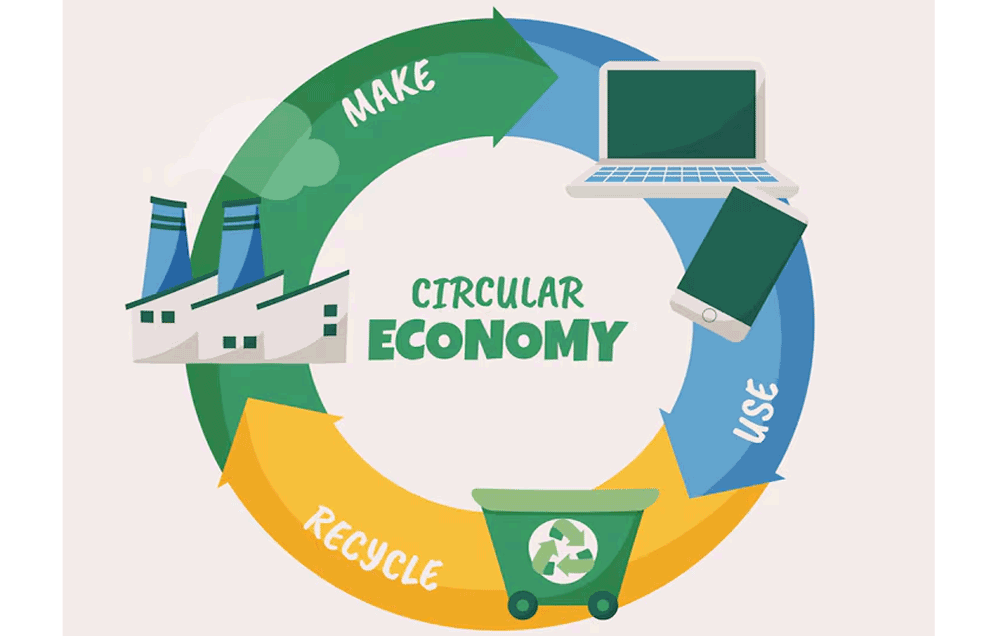
The Circular Economy and Net Zero Waste approach represents a fundamental shift from the traditional linear “take–make–dispose” model toward a regenerative system that eliminates waste, maximizes resource efficiency, and minimizes environmental impact. It focuses on keeping materials, products, and resources in use for as long as possible through reuse, recycling, recovery, redesign, and regeneration, while achieving net zero waste to landfill.
With rising concerns over resource scarcity, climate change, plastic pollution, landfill constraints, and ESG compliance, organizations across manufacturing, construction, FMCG, pharmaceuticals, logistics, infrastructure, and urban development are increasingly adopting circular economy principles. Global frameworks such as UN SDGs, EU Circular Economy Action Plan, ISO 14001, ISO 14051 (Material Flow Cost Accounting), Extended Producer Responsibility (EPR), and Net Zero commitments strongly emphasize waste reduction and circularity.
Traditional waste management systems largely focus on disposal and regulatory compliance. However, these approaches are no longer sufficient to meet sustainability goals. Circular Economy and Net Zero Waste strategies bridge this gap by promoting resource optimization, sustainable design, responsible consumption, waste valorization, and closed-loop systems.
This programme is designed to provide participants with a practical, structured, and implementable understanding of Circular Economy and Net Zero Waste, integrating global best practices, regulatory frameworks, ESG expectations, and recent trends such as zero-waste cities, circular supply chains, and digital waste tracking. The training emphasizes real-world applications, case studies, and implementation roadmaps, enabling organizations to transition toward sustainable and resilient operations.
Programme Structure
Module 1: Introduction to Circular Economy and Net Zero Waste
- Evolution of resource management: linear economy to circular economy
- Concept and principles of Circular Economy
- Understanding Net Zero Waste and zero-waste hierarchy
- Difference between waste management and waste elimination
- Circular economy and its role in sustainability and climate action
- Linkages with UN Sustainable Development Goals (SDGs)
- Benefits of circular economy: cost savings, risk reduction, innovation, and compliance
Module 2: Global Frameworks, Standards, and Policy Drivers
- Circular Economy Action Plan (EU) and global initiatives
- Indian regulatory landscape: Solid Waste Management Rules, Plastic Waste Management Rules, E-waste Rules, C&D Waste Rules
- Extended Producer Responsibility (EPR) and producer accountability
- ISO standards supporting circularity:
- ISO 14001 – Environmental Management
- ISO 14051 – Material Flow Cost Accounting
- ISO 59004/59010/59020 – Circular Economy standards
- Role of circular economy in ESG, BRSR, GRI, and sustainability reporting
- Market and investor expectations on waste and resource efficiency
Module 3: Waste Mapping and Material Flow Analysis
- Understanding waste streams across the value chain
- Types of waste: solid, liquid, hazardous, non-hazardous, and special wastes
- Waste characterization and quantification techniques
- Material Flow Analysis (MFA) and resource efficiency assessment
- Identifying waste hotspots and loss points
- Waste hierarchy: prevent, reduce, reuse, recycle, recover, dispose
- Data collection, tracking, and reporting best practices
Module 4: Circular Design and Resource Optimization
- Circular design principles and eco-design
- Design for durability, repairability, reuse, and recycling
- Sustainable material selection and substitution
- Packaging reduction and redesign strategies
- Industrial symbiosis and by-product utilization
- Circular procurement and supply chain integration
- Role of life-cycle thinking in circular economy
Module 5: Net Zero Waste Strategies and Technologies
- Developing a Net Zero Waste roadmap
- Waste minimization and source segregation strategies
- Recycling, composting, and bio-methanation
- Waste-to-energy and waste valorization options
- Management of plastic, e-waste, hazardous, and C&D waste
- Circular solutions for organic and food waste
- Evaluating environmental and economic feasibility
Module 6: Implementation, Monitoring, and Performance Measurement
- Setting Net Zero Waste targets and KPIs
- Leading vs. lagging indicators for waste performance
- Waste audits and compliance monitoring
- Digital tools for waste tracking and reporting
- Integration with Environmental Management Systems (EMS)
- Internal audits and management review
- Continuous improvement and corrective actions
Module 7: Circular Economy, ESG, and Business Value
- Circular economy as a driver for ESG performance
- Linking waste reduction with carbon footprint reduction
- Circular economy and Scope 3 emissions
- Financial benefits of circular business models
- Stakeholder engagement and employee involvement
- Communicating circular initiatives to customers and investors
- Risk management and resilience through circularity
Module 8: Case Studies, Best Practices, and Implementation Roadmap
- Circular economy applications in:
- Manufacturing and process industries
- Construction and infrastructure
- FMCG, packaging, and retail
- Pharmaceuticals and healthcare
- Urban and municipal waste systems
- Indian and global case studies on net zero waste
- Common challenges and barriers in implementation
- Change management for circular transition
- Step-by-step roadmap to implement circular economy and net zero waste
- Future trends: circular cities, regenerative systems, digital circularity
Eligibility
- Graduates / Diploma holders in Engineering, Science, Environmental Science, Sustainability, or allied disciplines
- EHS, ESG, and Sustainability professionals
- Waste management and environmental professionals
- Operations, supply chain, and facility managers
- Consultants, auditors, trainers, and faculty members
- Policy professionals and urban planners
Programme Duration
The duration of the training is 5 days.
Programme Mode
Registration is currently open for Part-time (Online Live Classes) mode.
Programme Deliverables
- Comprehensive study material for all modules (soft copy) aligned with current industry requirements
- Interactive live online sessions with expert faculty
- Practical insights supported by real-world examples
- Case studies and implementation guidance
- Participant feedback after each module
- All sessions conducted in English
Assessment & Certification
An online assessment will be conducted at the end of the programme. Upon successful completion, participants will be awarded the Professional Certification on Circular Economy and Net Zero Waste by the Centre for Environmental Health and Safety, IGMPI.
Discipline in Classes and Examination
Every student is required to observe a disciplined behaviour during her/his classes, assessments & examinations and to follow instructions from the Professors. Any act of indiscipline may result into discredit & it will be mentioned in her/his academic report.
Placement Assistance & Corporate Relations
The Institute supports career development through placement assistance and strong industry linkages across manufacturing, infrastructure, FMCG, pharmaceuticals, sustainability consulting, and environmental services.
Support includes:
- Resume development
- Interview preparation
- Mock interviews
- Career guidance and industry exposure
Future Career & Organizational Benefits
- Reduced waste generation and disposal costs
- Stronger ESG and sustainability performance
- Improved resource efficiency and operational resilience
- Enhanced regulatory compliance and brand value
- Career opportunities such as:
- Circular Economy Specialist
- Sustainability & ESG Manager
- Waste Management Consultant
- Resource Efficiency Analyst
- Environmental Auditor
- Sustainability Program Manager
Programme Fee Details
| S.No. | Programmes | Duration | Mode | Programmes Fee |
|---|---|---|---|---|
| 1 | Professional Certification | 5 Days | Part-time (Online Live Classes) | Rs.20,000/- (USD 400) |
*Institute of Good Manufacturing Practices India will provide a 10% fee concession on the programme fee to reserved category candidates - Scheduled Caste (SC), Scheduled Tribe (ST), Person with disability (PwD) and 5% fee concession for Other Backward Classes (OBC), Economical Weaker Session (EWS) and Ex-servicemen who enroll in PG Diploma programmes.
*Up to 30% Need-based programme fee waivers will be awarded to our PG Diploma students with excellent academic records requiring financial support from the Institute (A student’s family income is assessed based on various financial resources).
Advisory Board and team
Our Advisory Board Members : https://igmpi.ac.in/our-advisors-and-team
Centre for Environmental Health and Safety
C-6, Qutab Institutional Area, Near Old JNU Campus, New Delhi–110016, India.
18001031071
(Toll Free -9:00 am to 5:30 pm IST-except on Central Government holidays)/
info@igmpi.ac.in