
Institute of Good Manufacturing Practices India
Trusted by organization & traning participants in over 45 countries
Traning | Certification | Education | Research
Prospectus
Academic Year 2026-27
Post Graduate Diploma/ Executive Diploma in Life Sciences
igmpi.ac.inAbout IGMPI
The Institute of Good Manufacturing Practices India, an autonomous Institute recognised by Ministry of Commerce & Industry, accredited Vocational Institution of Ministry of Education, Government of India and approved by Food Safety and Standards Authority of India (FSSAI), presents a unique, friendly and interactive platform to get rid of all your GMP compliance related issues. GMP—an essential element of industries like pharmaceutical, cosmetic, Ayurveda, biotech, homeopathic, medical device and food manufacturing and sustainability services—in itself is the most dynamic part which witnesses frequent changes in terms of new rules being added and old ones being renewed. Thus, keeping oneself updated with current GMPs is essential to remain aligned with evolving industry requirement and standards.
Our team comprises knowledgeable professionals from diverse sectors such as Pharma, Healthcare, Food, Nutraceutical, and Nutrition industries, pooling together their expertise, know-how, and experiences to create this GMP guide. IGMPI is moving hand in hand with technology advances and has gained recognition as a stronger and better education and training platform provider for professionals and students in the areas of GMP, Quality Assurance and Control, Pharma, Food & Nutrition, Environment and Healthcare Regulatory Affairs, Clinical Research, Pharmaceutical IPR, Good Laboratory Practice and Product Management. Keeping pace with the digital era, IGMPI has also expanded into the domains of Geoinformatics, Remote Sensing, Cybersecurity, Information Security, and Network Security, preparing learners to address the growing need for secure and resilient information systems as well as advanced geospatial solutions.
Our board of governors and specialists have collated their acumen and are offering state-of-the-art courses which include GMP training, Quality Assurance and Control, Pharma and healthcare Regulatory Affairs, Clinical Research, Pharmaceutical IPR, Environment Social Governance (ESG), Good Laboratory Practice, Information Security Compliance and Remote Sensing. These are delivered in the form of formal classroom studies, online/interactive programmes, online seminars, and onsite training programmes, along with insights into global industry practices. In short, a round-the-clock service is provided for any information in these areas required by anybody from around the country and abroad.
Based on high standards of quality, the training programmes in Pharma, Healthcare and Food GMP, Quality Assurance and Quality Control, Regulatory Affairs, IPR, Pharma Product Management, Public Health, Hospital Management, Clinical Research, Pharmacovigilance, Medical Writing, Medical Coding, Nanotechnology, Drug Design and Discovery, Food QA&QC have been approved by the Quality Council of India, which is an autonomous body and an accreditation authority for education & vocational training providers under the Ministry of Commerce & Industry, Government of India. IGMPI is duly licensed and certified by Bureau of Indian Standards (BIS) under Bureau of Indian Standards (Conformity Assessment) Regulations 2018.
Accreditation and Awards
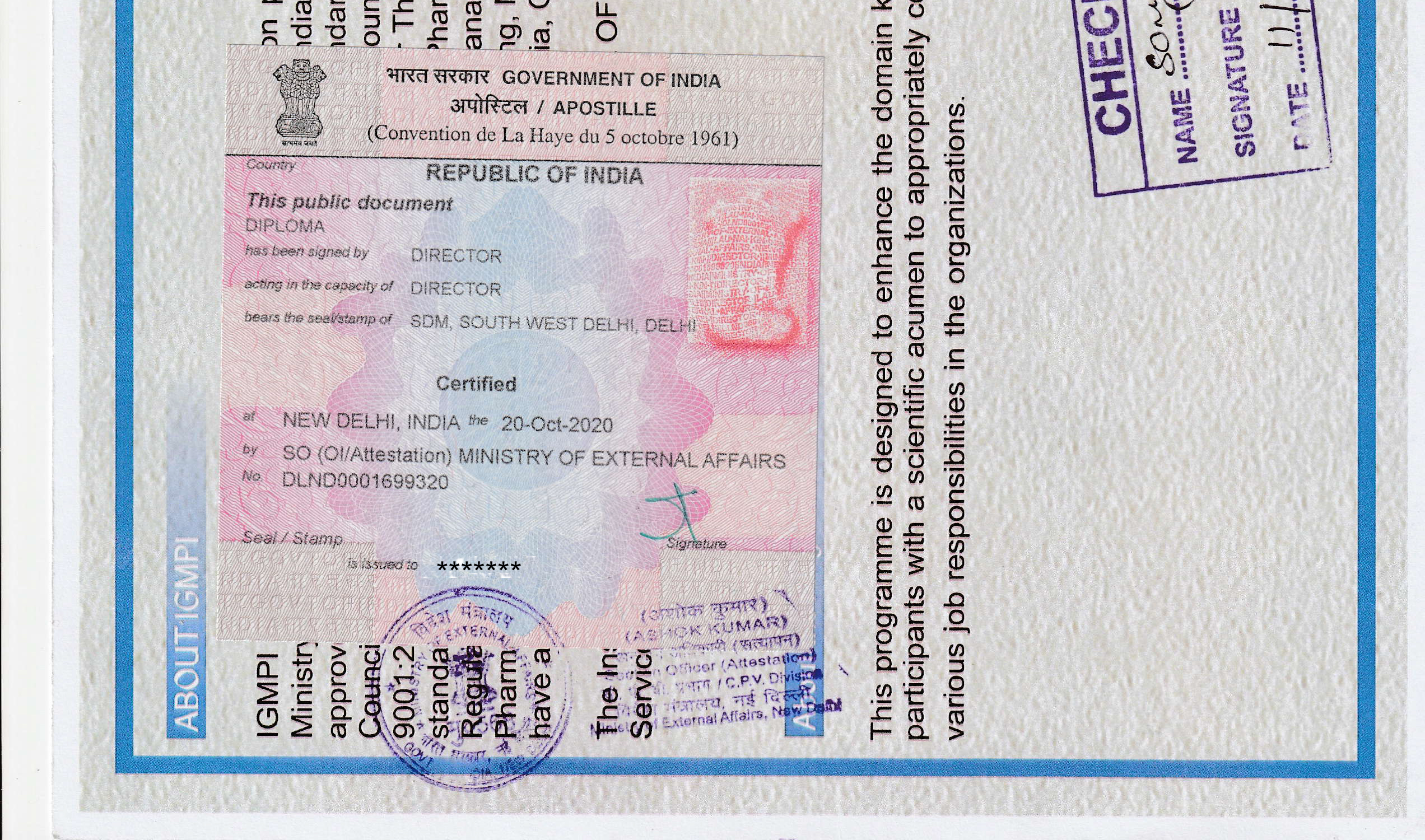
The Institute of Good Manufacturing Practices India, an autonomous Institute recognised by the Ministry of Commerce & Industry, Government of India is duly licensed and certified by Bureau of Indian Standards (BIS) under Bureau of Indian Standards (Conformity Assessment) Regulations 2018 (Active license number: ERO/EOMSM/L-8000027) for offering education and training programmes in the sectors of Pharmaceutical, Food & Nutrition, Healthcare, Environmental Health & Safety, Environmental Social and Governance (ESG), Psychology, Medical Devices, Cosmetics, Remote Sensing, Health Insurance, Product & Marketing Management, Cybersecurity, Fire Safety, and Renewable Energy in the regular Diploma (full or part-time) and online modes.


IGMPI is an accredited Vocational Institution (AVI no. 710367) of the Ministry of Education, Government of India. Institute of Good Manufacturing Practices India is Management System certified under NABCB accreditation. IGMPI is also approved by Food and Life Sciences Sector Skill Councils recognized by the National Council of Vocational Education and Training (NCVET).
The Post Graduate and Executive Diploma programmes of IGMPI in Good Manufacturing Practices, Regulatory Affairs, Intellectual Property Rights, Quality Assurance and Quality Control, Public Health, Nanotechnology, Hospital Management, Product Management, Sales and Marketing Management, Clinical Research, Medical Writing, Drug Discovery and Development, Pharmacovigilance, Medical Coding have been duly assessed and approved by Quality Council of India, Government of India based on fulfillment of QCI's following criteria:
    1. Course Content
    2. Course Design
    3. Course Material
    4. Instructors
    5. Class size & Attendance
    6. Facilities
    7. Evaluation of Students
    8. Written Examination
    9. Certificate
IGMPI is also approved by Food Safety and Standards Authority of India (FSSAI) (FSSAI ID: TPINS18). IGMPI® is licensed by Department of Food Safety & Drug Administration under the Drugs and Cosmetics Act, 1940 and registered under Food Safety and Standards Act 2006.
IGMPI is also approved by Sector Skills Council under National Skill Development Corporation (NSDC) setup by Ministry of Skill Development & Entrepreneurship, Govt of India (TC ID:TC342267).
IGMPI has been conferred with the prestigious "BUREAU OF INDIAN STANDARDS (BIS) AWARD OF HONOUR 2023". QUALITY COUNCIL OF INDIA (QCI) has also conferred IGMPI with D.L. SHAH NATIONAL QUALITY AWARD, Certificate of Merit & ASSOCHAM has conferred IGMPI with the Services Excellence Award based on excellence of its services to the students and training participants.
IGMPI's Membership with IPA
IGMPI is a Lifetime Institutional member of Indian Pharmaceutical Association (IPA).
Bureau of Indian Standards (BIS)
Bureau of Indian Standards (BIS) came into existence through an act of Parliament in 1987. BIS is the National Standard Body of India established under the BIS Act 2016 for the harmonious development of the activities of standardization, marking and quality certification of goods and for matters connected therewith or incidental thereto. The Bureau is a Body consisting of 25 members representing both Central and State governments, Members of Parliament, industry, scientific and research institutions, consumer organizations and professional bodies; with Union Minister of Consumer Affairs, Food and Public Distribution as its President and with Minister of State for Consumer Affairs, Food and Public Distribution as its Vice-President.
Quality Council of India (QCI)
Quality Council of India is set up by the Government of India to establish and operate national accreditation structure and promote quality through National Quality Campaign. QCI is registered as a non-profit society with its own Memorandum of Association. QCI is governed by a Council of 38 members and Chairman of QCI is appointed by the Prime Minister on recommendation of the industry to the government. The Department of Industrial Policy & Promotion, Ministry of Commerce & Industry, is the nodal ministry for QCI.
International Recognition
For providing its education and training services to overseas students, IGMPI is registered with the Directorate General of Foreign Trade, Government of India and our Export Import Code is AADCI7680Q.
IGMPI is an Institutional Member of the International Society for Quality in Health Care

Bureau of Indian Standards (BIS) is a member of International Organization for Standardization (ISO) and through the Indian National Committee (INC) which is a member of International Electrotechnical Commission (IEC). BIS is also a member of regional standards bodies like Pacific Area Standards Congress (PASC) and South Asian Regional Standards Organization (SARSO). India started taking part in IEC from 1911 and subsequently the then Indian Standards Institution (now BIS) took over the responsibility of Indian National Committee of IEC(INC-IEC) in 1949. Since then the INC-IEC is actively participating in the activities of the IEC both at the policy level and technical work and carrying out the responsibilities as member body of IEC Council. India is a member in Standards Management Board (SMB) of IEC since 2015.BIS has also signed Bilateral Cooperation Agreements (BCA)/Mutual Recognition Agreements (MRA) with the National Standards Bodies of several countries like Afghanistan, Bangladesh, Belarus, Egypt, European Union , Germany, Ghana, Greece, Indonesia, Iran, Japan, Jordon, Kenya, Kyrgyzstan, Mali, Mauritius, Nigeria, Russia, Saudi Arabia , Slovakia, Slovenia, Suriname, USA, UAE, Uzbekistan, Viet Nam, Bhutan, Brazil, Israel, Nepal, Pakistan and Sri Lanka.
National Accreditation Board for Certification Bodies (NABCB), Quality Council of India is a member of International Accreditation Forum (IAF) & Pacific Accreditation Cooperation (PAC) as well as signatory to its MLAs for Quality Management Systems, Environmental Management Systems and Product Certification. NABCB is also a Full Member of International Laboratory Accreditation Cooperation (ILAC) & Asia Pacific Laboratory Accreditation Cooperation (APLAC) as well as signatory to its MRAs for Inspection.
Post Graduate Diploma/ Executive Diploma in Life Sciences
This Programme is devised with comprehensive academic planning to impart fundamental and interdisciplinary knowledge across core life science domains. It is designed especially for students from diverse educational backgrounds who may not have prior exposure to life sciences but wish to build a strong foundation in this field.
The programme provides essential understanding of biological systems, biomolecules, human physiology, food and nutrition, and basic scientific principles required for progression into advanced domains such as pharmaceuticals, biotechnology, healthcare, food science, and nutrition. It equips learners with the ability to understand core biological processes, interpret scientific information, and apply foundational concepts in real-world contexts.
The course emphasizes conceptual clarity, simplified learning of technical concepts, and their relevance in healthcare, pharmaceutical, food, and allied industries. It also develops analytical thinking and problem-solving skills necessary for academic advancement and entry-level professional roles across life science sectors.
Programme Modules
International Affiliation with
Module 1: Basic Chemistry for Life Sciences
-
Atomic structure, chemical bonding, and molecular interactions
-
pH, buffers, and solutions
-
Functional groups relevant to biological systems
-
Chemical reactions in biological systems
Module 2: Biochemistry
-
Introduction to biomolecules: carbohydrates, lipids, proteins, nucleic acids
-
Amino acids and protein structure
-
Enzymes and enzyme kinetics
-
Overview of metabolic pathways
Module 3: Cell Biology & Molecular Biology
-
Cell structure and organelles
-
Membrane transport mechanisms
-
DNA and RNA structure
-
Replication, transcription, and translation
Module 4: Genetics
-
Gene structure and function
-
Principles of inheritance
-
Mutations and genetic variation
Module 5: Microbiology
-
Classification of microorganisms
-
Growth and control of microbes
-
Sterilization and disinfection methods
Module 6: Human Anatomy & Physiology
-
Levels of biological organization
-
Homeostasis
-
Overview of all major systems
-
Coordination of body functions
Module 7: Fundamentals of Nutrition
-
Macronutrients and micronutrients
-
Functions and dietary sources
-
Digestion and absorption
-
Energy balance
Module 8: Food Science
-
Physical and Chemical components of food
-
Food spoilage
-
Food preservation techniques
-
Food safety principles
Module 9: Analytical & Laboratory Techniques
-
GLP & Lab Demonstration
-
Sampling and Analysis
-
Analytical techniques
-
Quality control and testing procedures
Module 10: Biostatistics
-
Types of data and data presentation
-
Measures of central tendency and dispersion
-
Basic probability concepts
-
Introduction to data interpretation
Module 11: Research Methodology
-
Introduction to research design
-
Data collection methods
-
Research ethics
-
Scientific writing and documentation
Module 12: Biotechnology
-
Basic concepts of recombinant DNA technology
-
Common biotechnological techniques
-
Applications in healthcare, agriculture, and industry
Module 13: Environmental Biology & Health
-
Ecosystem structure and function
-
Environmental pollutants and their impact
-
Public health concepts
-
Waste management principles
Module 14: Case Studies in Life Sciences
Module 15: Capstone Project
Eligibility
Graduates in any discipline are eligible for our Post Graduate Diploma, Executive Diploma and Professional Certifications Programmes. 10+2 pass-outs are eligible for our Under Graduate Diploma and Diploma holders of two to three years course duration are also eligible for the PG Diploma.
Programme Duration
The minimum duration to complete the PG diploma programme is 12 months and maximum is 24 months. The minimum duration to complete the executive diploma programme is 6 months and maximum is 12 months.
Programme Mode
Registrations are currently open for regular and Part-time (Online Live Classes) both modes.
Programme Deliverables
-
Comprehensive study material for all the modules ensuring alignment with academic and industry requirements
-
Assignments for all the programme modules for continuous evaluation and guidance
-
Interactive or online live sessions on all key areas of the programme providing flexibility to participants
-
Online classes for all modules conducted on weekends along with scheduled doubt-clearing sessions
-
Faculty support to ensure clarity of concepts for learners from diverse backgrounds
-
Assessment and evaluation for all modules to enhance competencies and application skills
-
Feedback collection at the end of each module through structured questionnaires
-
All learning and training delivery initiatives conducted in English
Examination & Certification
All participants are required to submit assignments for each module and appear for an online examination. Successful completion of the capstone project is mandatory. Upon completion, participants will be awarded a PGD/ED Diploma in Life Sciences.
Placement Assistance & Corporate Relations
The Institute supports participants through placement assistance and maintains strong connections with industry professionals and organizations across pharmaceutical, healthcare, and food sectors. Guidance is also provided for resume building, interview preparation, and skill development.
Future career prospects
The Diploma in Integrated Life Sciences provides a strong foundation for progression into higher studies and specialized programmes in pharmacy, biotechnology, clinical research, nutrition, food science, and healthcare. It also opens pathways for entry-level roles in pharmaceutical industries, healthcare organizations, food and nutrition sectors, and research-oriented environments.
Programme Fee Details
| S.No. | Programmes | Duration | Mode | Programmes Fee |
|---|---|---|---|---|
| 1 | Post Graduate Diploma | 12 Months | Part-time (Online Live Classes) | Rs.88,700/- (USD 1650) |
| 2 | Under Graduate Diploma | 12 Months | Part-time (Online Live Classes) | Rs.88,700/- (USD 1650) |
| 3 | Executive Diploma | 6 Months | Part-time (Online Live Classes) | Rs.68,500/- (USD 1340) |
| 4 | Post Graduate Diploma | 12 Months | Regular Mode | Rs.1,10,000/- (USD 4620) |
| 5 | Under Graduate Diploma | 12 Months | Regular Mode | Rs.1,10,000/- (USD 4620) |
*Institute of Good Manufacturing Practices India will provide a 10% fee concession on the programme fee to reserved category candidates - Scheduled Caste (SC), Scheduled Tribe (ST), Person with disability (PwD) and 5% fee concession for Other Backward Classes (OBC), Economical Weaker Session (EWS) and Ex-servicemen who enroll in PG Diploma programmes.
*Up to 30% Need-based programme fee waivers will be awarded to our PG Diploma students with excellent academic records requiring financial support from the Institute (A student’s family income is assessed based on various financial resources).
Advisory Board and team
Our Advisory Board Members : https://igmpi.ac.in/our-advisors-and-team

Institute of Good Manufacturing Practices India
C-6, Qutab Institutional Area, Near Old JNU Campus, New Delhi–110016, India.
18001031071
(Toll Free -9:00 am to 5:30 pm IST-except on Central Government holidays)/
info@igmpi.ac.in